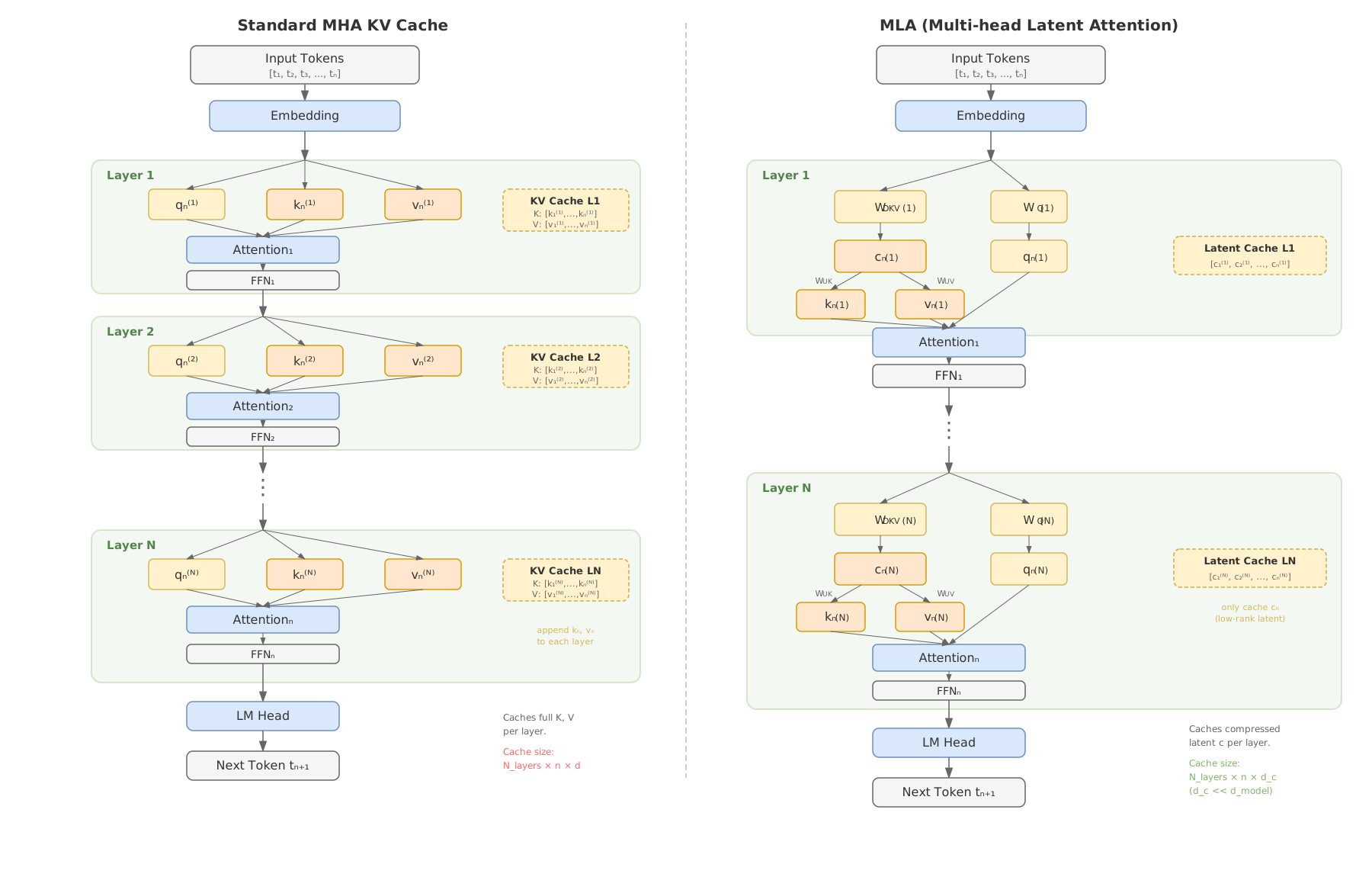
Setup
- Model: L layers, hidden dimension \(d\) = 7168, num_heads \(h\) = 128, head_dim \(d_h\) = 128 (so \(d = h × d_h\), for deepseek V3 like setting)
- MLA latent dimension: \(d_c\) = 512 (compressed KV latent)
- Sequence: tokens t₁, t₂, ..., t₁₀₀
- Assume t₁ to t₉₉ are already cached (prefill done). Now we process t₁₀₀ (decode step).
Standard MHA: Step-by-step for t₁₀₀
Step 1: Embedding
x₁₀₀ = Embedding(t₁₀₀) # shape: (d,) = (7168,)
Step 2: Layer 1
Compute Q, K, V for the new token:
q₁₀₀⁽¹⁾ = x₁₀₀ · W_Q⁽¹⁾     # (7168,) × (7168, 7168) → (7168,) i.e. (h × d_h)
k₁₀₀⁽¹⁾ = x₁₀₀ · W_K⁽¹⁾     # (7168,) × (7168, 7168) → (7168,)
v₁₀₀⁽¹⁾ = x₁₀₀ · W_V⁽¹⁾     # (7168,) × (7168, 7168) → (7168,)
Concat with cached K, V from tokens 1~99:
K⁽¹⁾ = concat(KV_Cache_K⁽¹⁾, k₁₀₀⁽¹⁾)   # (99, 7168) + (1, 7168) → (100, 7168)
V⁽¹⁾ = concat(KV_Cache_V⁽¹⁾, v₁₀₀⁽¹⁾)   # (99, 7168) + (1, 7168) → (100, 7168)
Update cache:
KV_Cache_K⁽¹⁾ ← K⁽¹⁾    # now stores (100, 7168)
KV_Cache_V⁽¹⁾ ← V⁽¹⁾    # now stores (100, 7168)
Compute attention (per head, d_h = 128):
# Reshape to heads: Q → (h, 1, d_h), K → (h, 100, d_h), V → (h, 100, d_h)
attn_weights = softmax(q₁₀₀⁽¹⁾ · K⁽¹⁾ᵀ / √d_h)   # (h, 1, 100)
attn_output = attn_weights · V⁽¹⁾                     # (h, 1, d_h) → concat → (7168,)
FFN:
h₁₀₀⁽¹⁾ = FFN(LayerNorm(attn_output + x₁₀₀)) # (7168,)
Step 3: Layer 2
Same as Layer 1, but input is h₁₀₀⁽¹⁾:
q₁₀₀⁽²⁾ = h₁₀₀⁽¹⁾ · W_Q⁽²⁾
k₁₀₀⁽²⁾ = h₁₀₀⁽¹⁾ · W_K⁽²⁾
v₁₀₀⁽²⁾ = h₁₀₀⁽¹⁾ · W_V⁽²⁾

K⁽²⁾ = concat(KV_Cache_K⁽²⁾, k₁₀₀⁽²⁾)   # (100, 7168)
V⁽²⁾ = concat(KV_Cache_V⁽²⁾, v₁₀₀⁽²⁾)   # (100, 7168)
... (same attention + FFN) ...
Step 4: Repeat for Layers 3 ~ L
Each layer independently caches its own K and V.
Step 5: Output
logits = h₁₀₀⁽ᴸ⁾ · W_head    # → vocabulary distribution
t₁₀₁ = argmax(logits)
Cache Size (MHA)
Total cache = L × n × 2 × d
            = L × 99 × 2 × 7168
For L=60, n=99:
= 60 × 99 × 2 × 7168 = 85,155,840 parameters (per sequence)
≈ 85M × 2 bytes (FP16) ≈ 162 MB
MLA (Multi-head Latent Attention): Step-by-step for t₁₀₀
Step 1: Embedding
x₁₀₀ = Embedding(t₁₀₀) # shape: (d,) = (7168,)
Step 2: Layer 1
Down-project to compressed latent (for KV):
c₁₀₀⁽¹⁾ = x₁₀₀ · W_DKV⁽¹⁾ # (7168,) × (7168, 512) → (512,)
Compute Q separately:
q₁₀₀⁽¹⁾ = x₁₀₀ · W_Q⁽¹⁾ # (7168,) × (7168, 7168) → (7168,)
Update latent cache (only store c, NOT full K,V):
Latent_Cache⁽¹⁾ ← concat(Latent_Cache⁽¹⁾, c₁₀₀⁽¹⁾) # (99, 512) + (1, 512) → (100, 512)
Up-project ALL cached latents to K, V (on-the-fly):
K⁽¹⁾ = Latent_Cache⁽¹⁾ · W_UK⁽¹⁾    # (100, 512) × (512, 7168) → (100, 7168)
V⁽¹⁾ = Latent_Cache⁽¹⁾ · W_UV⁽¹⁾    # (100, 512) × (512, 7168) → (100, 7168)
Compute attention (same as MHA from here):
attn_weights = softmax(q₁₀₀⁽¹⁾ · K⁽¹⁾ᵀ / √d_h)   # (h, 1, 100)
attn_output = attn_weights · V⁽¹⁾                     # → (7168,)
FFN:
h₁₀₀⁽¹⁾ = FFN(LayerNorm(attn_output + x₁₀₀)) # (7168,)
Step 3: Layer 2
Same structure, input is h₁₀₀⁽¹⁾:
c₁₀₀⁽²⁾ = h₁₀₀⁽¹⁾ · W_DKV⁽²⁾    # → (512,)
q₁₀₀⁽²⁾ = h₁₀₀⁽¹⁾ · W_Q⁽²⁾      # → (7168,)

Latent_Cache⁽²⁾ ← concat(Latent_Cache⁽²⁾, c₁₀₀⁽²⁾)  # (100, 512)

K⁽²⁾ = Latent_Cache⁽²⁾ · W_UK⁽²⁾    # (100, 7168)
V⁽²⁾ = Latent_Cache⁽²⁾ · W_UV⁽²⁾    # (100, 7168)
... (attention + FFN) ...
Step 4: Repeat for Layers 3 ~ L
Step 5: Output
Same as MHA.
Cache Size (MLA)
Total cache = L × n × d_c
            = L × 99 × 512
For L=60, n=99:
= 60 × 99 × 512 = 3,041,280 parameters (per sequence)
≈ 3M × 2 bytes (FP16) ≈ 5.8 MB
Side-by-side Comparison
| Standard MHA | MLA | |
|---|---|---|
| What is cached per token per layer | k (7168) + v (7168) = 14,336 | c (512) |
| Cache size per token per layer | 2 × d = 14,336 | d_c = 512 |
| Compression ratio | 1× (baseline) | d_c / (2d) = 512/14336 ≈ 1/28 |
| Total cache (L=60, n=99) | ~162 MB | ~5.8 MB |
| Extra compute at decode | None | Up-project c → K, V per step |
| Accuracy trade-off | Full rank | Low-rank approximation (minimal loss in practice) |
Key Insight
MHA caches the full K and V vectors for every token at every layer. This grows linearly with sequence length and is the main memory bottleneck for long-context inference.
MLA compresses the KV information into a much smaller latent vector c via a learned down-projection \(W_{DKV}\) (see blog before). At attention time, it reconstructs K and V by up-projecting c with \(W_{UK}\) and \(W_{UV}\). The trade-off is a small amount of extra compute (matrix multiply for up-projection) in exchange for ~28× less cache memory.
This is why DeepSeek V3 can handle much longer contexts with the same GPU memory budget.
Note on Actual Implementation
In practice, DeepSeek V3's MLA also handles the Q side with compression (down-project then up-project for Q as well), and uses RoPE (Rotary Position Embedding) on a separate small portion of the key. The above is simplified to show the core KV cache difference.